


How to Design Chemical Dosing Systems: Accuracy, Safety and Material Selection
- Blog
- How to Design Chemical Dosing Systems: Accuracy, Safety and Material Selection
How to Design Chemical Dosing Systems: Accuracy, Safety and Material Selection
Table of Contents
- What is a Chemical Dosing System?
- Applications
- Selecting a Dosing Pump
- Material Compatibility
- Injection Point Design
- Accuracy and Control
- Safety Measures
- Chemical Dosing in CIP Systems
- Maintenance and Operation
- Frequently Asked Questions
- Conclusion
Chemicals are used across industrial facilities for a wide range of purposes, including cleaning, water conditioning, pH adjustment, disinfection, and process reactions. Delivering these chemicals into a process safely, accurately, and at the right time is the responsibility of chemical dosing systems. Under-dosing can cause process failures, while over-dosing leads to inflated operating costs, product quality deviations, and serious safety hazards. This article examines the core engineering principles for designing chemical dosing systems.
What is a Chemical Dosing System?
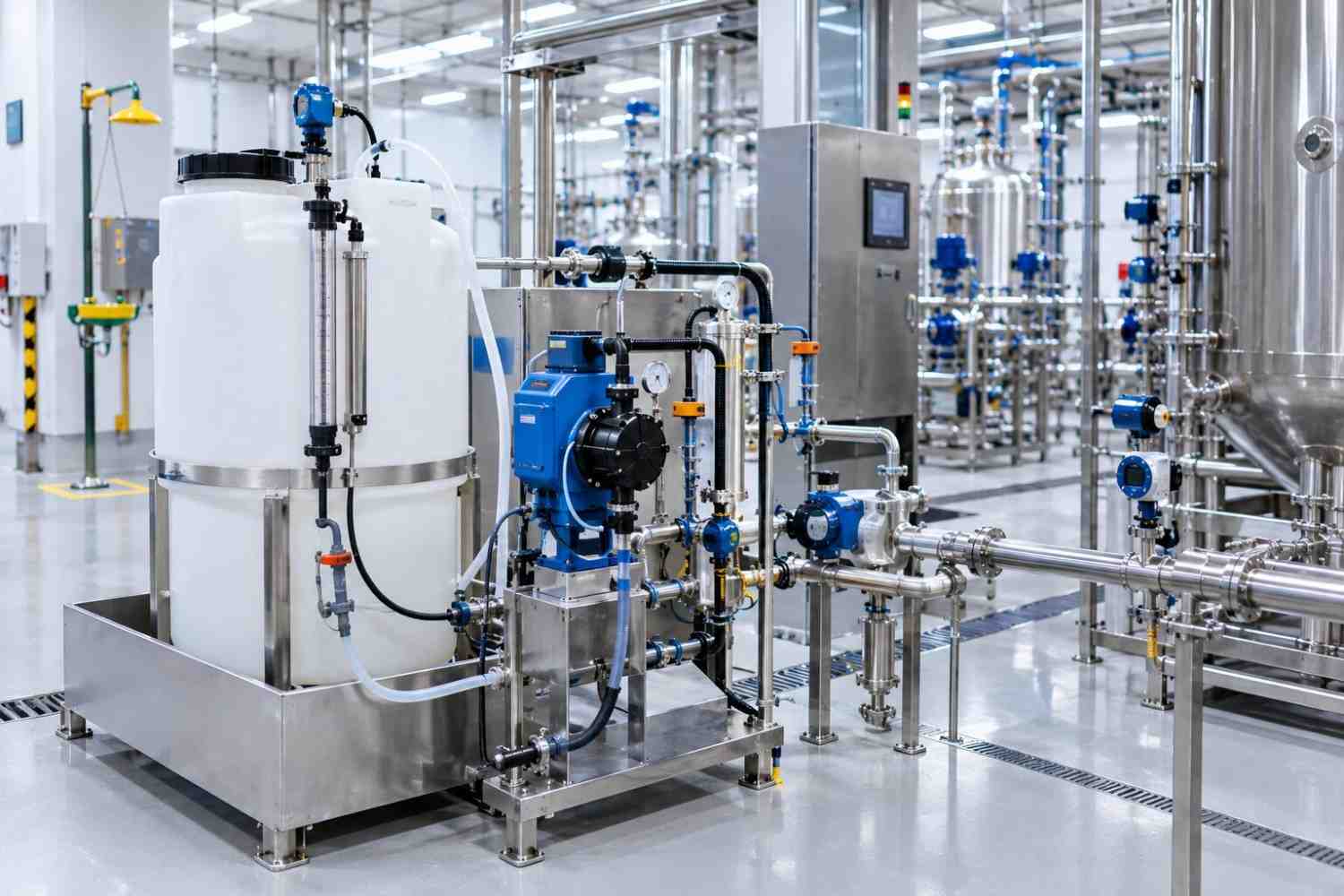
A chemical dosing system is an integrated assembly comprising chemical storage tanks or containers, a dosing pump, suction and discharge piping, measurement and control instrumentation, and safety hardware. The system injects a chemical into the primary process line at a defined rate or quantity. Dosing can be governed by a fixed flow rate, proportional to main process flow, or dynamically adjusted based on analytical feedback signals such as pH or conductivity.
Applications
- Dosing caustic and acid cleaning solutions in Clean-in-Place (CIP) systems
- Adding antiscalants, disinfectants, and pH adjustment chemicals in water treatment units
- Boiler feedwater and cooling tower conditioning
- Wastewater neutralization
- Adding specialized liquid additives in continuous process reactions
Selecting a Dosing Pump
Dosing pumps are positive displacement pumps designed to meter small fluid volumes with high precision. Diaphragm dosing pumps are the industry standard because the metered chemical remains entirely isolated from mechanical drive components, ensuring leak-free operation. Key factors to evaluate during pump selection include:
- Minimum and maximum required flow rates and turn-down ratio
- Backpressure at the injection point
- Fluid viscosity and off-gassing tendencies
- Chemical compatibility of the pump head, diaphragm, valves, and seals
- Integration capabilities with control signals and automation systems
Material Compatibility
Every wetted component in a dosing system must be chemically compatible with the media handled. While stainless steel is suitable for many industrial chemicals, it degrades rapidly when exposed to certain acids or chloride compounds. In these environments, polymers such as PVDF, PP, and PTFE are preferred. Gaskets, flexible tubing, and sensor bodies require the same rigorous evaluation. When assessing compatibility, fluid concentration and operating temperature must be considered alongside chemical composition, as concentration or temperature shifts can dramatically alter material resistance.
Injection Point Design
The design of the injection point directly impacts dosing efficiency. To ensure rapid, homogeneous blending into the main process stream, the injection Quill should be positioned strategically, with static mixers added when necessary. An isolation and non-return injection valve prevents backflow of process fluid into the chemical delivery line. For media prone to crystallization, specific anti-clogging features must be incorporated at the injection interface.
The physical location of the injection point must also be coordinated with downstream analytical sensors. In closed-loop feedback control, the sensing probe should be positioned where the chemical is fully mixed. Installing the sensor too close to the injection point results in readings of unmixed chemical pockets, causing control loop instability. Conversely, locating the sensor too far downstream introduces measurement lag, causing continuous overshoot or undershoot against process setpoints.
Accuracy and Control
Dosing accuracy can be affected by pump calibration, suction head conditions, entrained gas bubbles, and backpressure variations. For critical applications, actual delivery rates should be verified using inline flow meters or loss-in-weight monitoring. A calibration column allows operators to perform field checks quickly. In closed-loop control architectures, chemical delivery is adjusted automatically based on measured process variables, an approach widely used in pH and conductivity control.
Safety Measures
Handling industrial chemicals introduces inherent health and environmental risks. Engineering controls must include the following safety features:
- Bunded containment basins sized to hold chemical tank capacity
- Physical segregation of incompatible chemical storage areas
- Pressure relief valves on positive displacement discharge lines to prevent over-pressurization
- Level transmitters and low-level cut-off switches to prevent dry running
- Emergency eyewash and safety shower stations located nearby
- Clear, compliant labeling on all storage vessels and delivery lines
Chemical Dosing in CIP Systems
In Clean-in-Place systems, chemical concentration is a primary parameter determining cleaning efficacy. Concentrated chemicals are metered into the detergent tank or inline CIP feed based on continuous conductivity measurement. Maintaining chemical concentrations within target bands guarantees sanitation quality while eliminating wasted chemical consumption. Automated dosing logs also serve as critical audit records for process validation. When designing custom CIP systems, chemical dosing units must be engineered as an integral core module.
Maintenance and Operation
Dosing pump diaphragms, check valves, and seals must be inspected regularly and replaced as part of a preventive maintenance schedule. Suction strainers require periodic cleaning, and delivery lines should be checked for crystallization or fouling. Pump calibration should also be verified on a set schedule. When changing chemical drums or flushing lines, technicians must follow strict drainage protocols and wear appropriate personal protective equipment (PPE).
Monitoring chemical consumption trends over time provides valuable operational insights. Higher-than-expected usage can indicate calibration drift, line leaks, or altered process conditions. Routine review of consumption data supports cost control and enables early detection of mechanical faults.
Frequently Asked Questions
Should I use a motorized dosing pump or a proportional water-powered doser?
Motorized or solenoid-driven dosing pumps are best for applications requiring variable output, precise signal integration, or closed-loop control. Water-powered proportional dosers are suitable for simpler water conditioning tasks where dosing must match main line flow without external electrical power.
Can the same dosing pump be used for different chemicals?
This is generally not recommended. Cross-contamination risks, chemical reactions, and differing material compatibility requirements make dedicated pumps and lines the safer, more reliable choice.
How long can a chemical dosing line be?
Excessively long dosing lines cause response lag, increase the risk of air binding, and reduce metering accuracy. Dosing pumps should be installed as close to the injection point as practical layout constraints allow.
A well-engineered chemical dosing system relies on accurate pump selection, compatible materials, an optimized injection point, robust control loops, and comprehensive safety features. To discuss chemical dosing solutions for your utility facilities, contact our engineering team.