


Hygienic Gasket Materials: Comparing EPDM, FKM, Silicone and PTFE
- Blog
- Hygienic Gasket Materials: Comparing EPDM, FKM, Silicone and PTFE
Hygienic Gasket Materials: Comparing EPDM, FKM, Silicone and PTFE
Table of Contents
- Why Gasket Selection Matters
- EPDM
- FKM
- Silicone
- PTFE
- Comparison Matrix
- Key Selection Criteria
- Regulatory Compliance and Certification
- Gasket Service Life and Replacement Strategy
- Common Pitfalls
- Frequently Asked Questions
- Conclusion
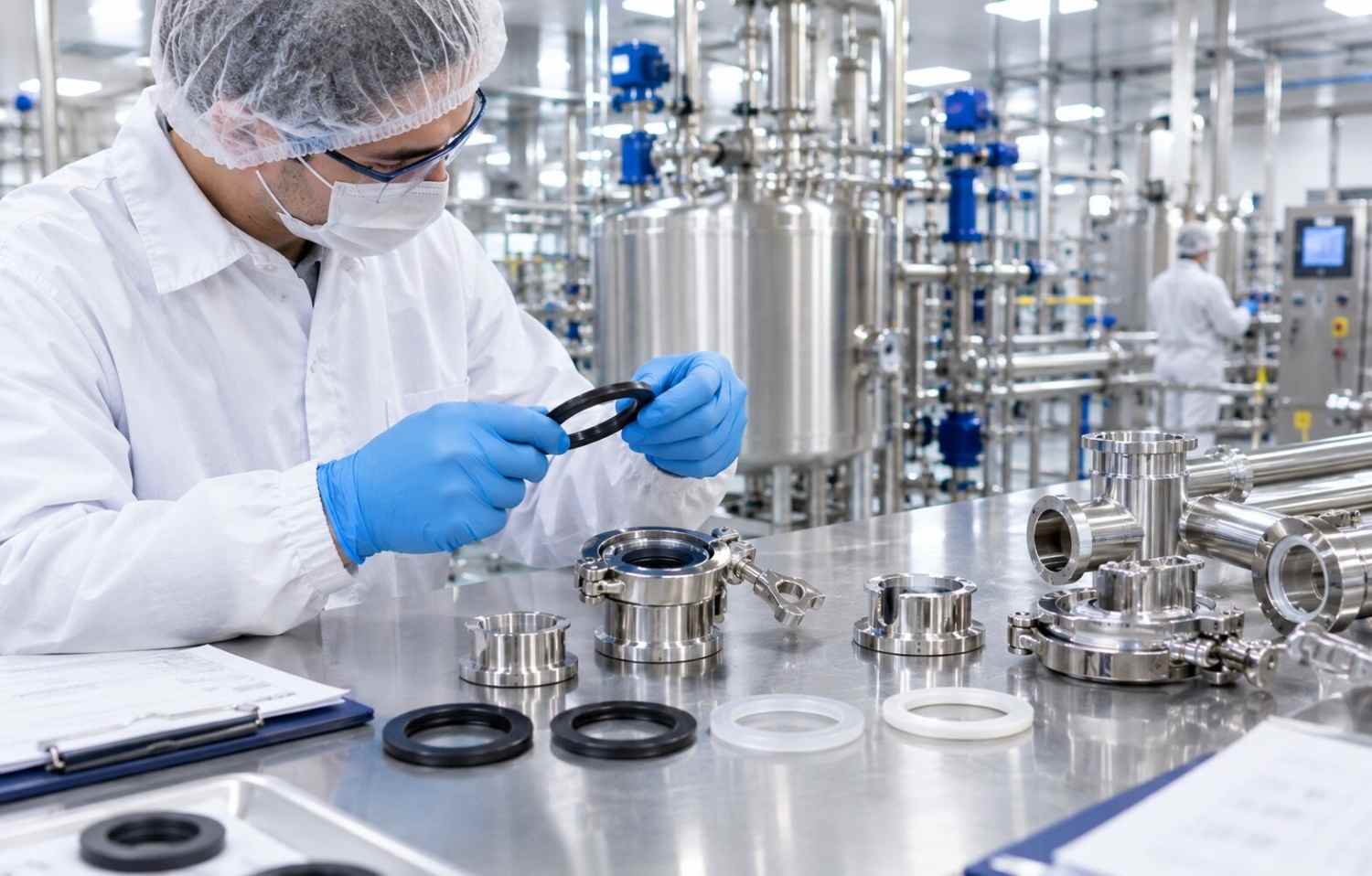
No matter the quality of stainless steel tubing and processing equipment in a hygienic system, gaskets represent the most vulnerable seal points. Gaskets maintain direct, continuous contact with process media, aggressive cleaning chemicals, and high-temperature sterilization steam. Selecting an improper gasket material can lead to swelling, hardening, cracking, extractable leaching, or complete seal failure. Below, we examine the primary gasket materials utilized in sanitary process applications and the critical parameters governing their selection.
Why Gasket Selection Matters
In hygienic design, a gasket serves as both a physical seal and an integral cleanability barrier. An incompatible gasket degrades over time, forming micro-fissures and surface pores where microorganisms collocate and multiply. Chemical swelling causes elastomeric intrusion into the process pipeline, disrupting fluid dynamics and trapping particulates. Furthermore, all wetted gasket compounds must comply with strict food contact and pharmaceutical regulations to prevent product contamination through chemical leaching.
EPDM
Ethylene Propylene Diene Monomer (EPDM) is a widely used elastomer across hygienic processing industries. It exhibits excellent resistance to hot water and saturated steam, making it a reliable choice for lines undergoing frequent Clean-in-Place (CIP) and Sterilization-in-Place (SIP) cycles. EPDM demonstrates strong compatibility with most dilute acidic and alkaline cleaning agents. However, it displays poor resistance to fats, oils, and non-polar solvents. Fatty food products or solvent-heavy processing lines require alternative gasket materials.
FKM
Fluoroelastomer (FKM) delivers high chemical resistance to oils, fats, fuels, and aggressive chemical processing compounds. It is commonly selected for fatty food matrices, dairy processing, and specialized chemical syntheses. While FKM retains mechanical properties at elevated temperatures, its long-term resistance to high-pressure saturated steam is inferior to EPDM. Manufacturer compatibility curves must be evaluated for installations utilizing steam sterilization.
Silicone
Silicone exhibits high physiological inertness, flexibility across broad temperature ranges, and minimal compression set. Platinum-cured silicone is widely specified across pharmaceutical and biotechnology manufacturing. Its ability to maintain elasticity at sub-zero and elevated temperatures provides operational advantages. However, silicone features lower mechanical strength and abrasion resistance compared to other synthetic elastomers. Prolonged exposure to concentrated steam can cause material degradation, necessitating planned replacement schedules in SIP-heavy systems.
PTFE
Polytetrafluoroethylene (PTFE) offers near-universal chemical inertness, a non-stick surface profile, and an ultra-wide thermal operating window. It is ideal for aggressive solvent lines and processes where media adherence must be completely prevented. Because PTFE is a non-elastic fluoropolymer, it is susceptible to cold flow (creep) under continuous mechanical compression and thermal cycling. Consequently, solid PTFE gaskets are installed in specialized joint designs or encapsulated around elastomeric cores.
Comparison Matrix
- Steam and Hot Water Resistance: EPDM exhibits superior resistance; Silicone and FKM require process-specific evaluation; PTFE offers high thermal limits but risks cold-flow deformation.
- Oil and Fatty Media Resistance: FKM and PTFE offer strong performance; EPDM exhibits poor compatibility.
- Chemical Resistance: PTFE provides near-universal compatibility; FKM covers a wide operational spectrum; EPDM is highly compatible with common CIP chemicals.
- Flexibility and Elasticity: Silicone and EPDM offer high elasticity; PTFE is non-elastic.
- Mechanical Strength: Silicone exhibits moderate strength; FKM and EPDM provide high tear and wear resistance.
Key Selection Criteria
Gasket selection must not rely on a single environmental variable. Engineers must evaluate product fluid composition, peak process temperatures and pressures, CIP chemical types and concentrations, SIP parameters, connection geometry, and regulatory compliance requirements in parallel. When a single process line experiences varying conditions, distinct gasket compounds may be required at different process boundaries. To prevent maintenance mix-ups, gaskets should feature distinct color codes or markings, backed by clear documentation in plant maintenance logs.
Regulatory Compliance and Certification
Gasket materials specified for food, beverage, and pharmaceutical processing must provide verified regulatory compliance. Declarations of conformity for food contact, bio-compatibility testing, and extractable/leachable testing (such as USP Class VI) are standard project requirements. These certificates must be integrated into the equipment handover package and validation documentation. Purchase orders should mandate the inclusion of batch-traceable material certificates with every gasket delivery.
Gasket Service Life and Replacement Strategy
The operational lifespan of a sanitary gasket depends directly on environmental exposure. Frequent steam cycles, aggressive sanitizers, and high thermal differentials accelerate material degradation. Critical process lines require defined gasket replacement intervals, logged maintenance records, and detailed inspections of removed seals for signs of hardening, micro-cracking, swelling, or color changes. Tracking these parameters helps optimize preventive maintenance cycles. In our installation services, gasket selection is verified against process and cleaning profiles during engineering review.
Common Pitfalls
Frequent field errors include installing EPDM gaskets in oily media lines, specifying non-steam-rated polymers in SIP lines, mixing up gasket materials during routine maintenance, and over-torquing fittings, which causes gasket intrusion into the inner pipe diameter. Most of these mistakes stem from selecting gaskets based solely on connection size rather than analyzing full chemical and thermal operating parameters.
Warehouse inventory management plays an equally critical role in preventing seal failures. Gaskets must be stored in organized, clearly labeled compartments with active shelf-life tracking. Synthetic elastomers degrade if exposed to prolonged UV light, heat, or ozone. Storing spares in temperature-controlled, dark environments following First-In, First-Out (FIFO) principles ensures gaskets arrive on the factory floor in prime condition.
Frequently Asked Questions
Can a single gasket material be standardized across an entire facility?
If operating conditions, cleaning regimens, and process fluids are uniform across all lines, standardizing on a single material simplifies maintenance inventory. However, if conditions vary—such as combining fatty media with steam-sterilized purities—material selection must be optimized by process zone.
Does gasket color reliably indicate material type?
Not always. While some manufacturers utilize standard color-coding, color formulations vary across suppliers. Material type must always be verified using batch documentation, part numbers, and etched markings.
When should sanitary gaskets be replaced?
Gaskets should be replaced at predetermined preventive maintenance intervals or immediately upon detecting hardening, cracking, permanent deformation, or swelling during routine inspection. On critical lines, proactive replacement prevents unpredicted process downtime.
Selecting gaskets for hygienic piping systems requires balancing process media characteristics, operating temperatures, chemical cleaning agents, and thermal sterilization methods. EPDM, FKM, Silicone, and PTFE each offer distinct performance advantages. Contact us to review your process parameters and establish an optimized gasket specification and maintenance plan.