


PLC and SCADA Integration in Process Automation: Where Piping Meets Control
- Blog
- PLC and SCADA Integration in Process Automation: Where Piping Meets Control
PLC and SCADA Integration in Process Automation: Where Piping Meets Control
Table of Contents
- What is a PLC?
- What is SCADA?
- The Relationship Between Piping Design and Automation
- Automated Valves and Position Feedback
- CIP and SIP Automation
- Recipe Management
- Data Logging and Data Integrity
- Commissioning and Testing
- Common Field Challenges
- Frequently Asked Questions
- Conclusion
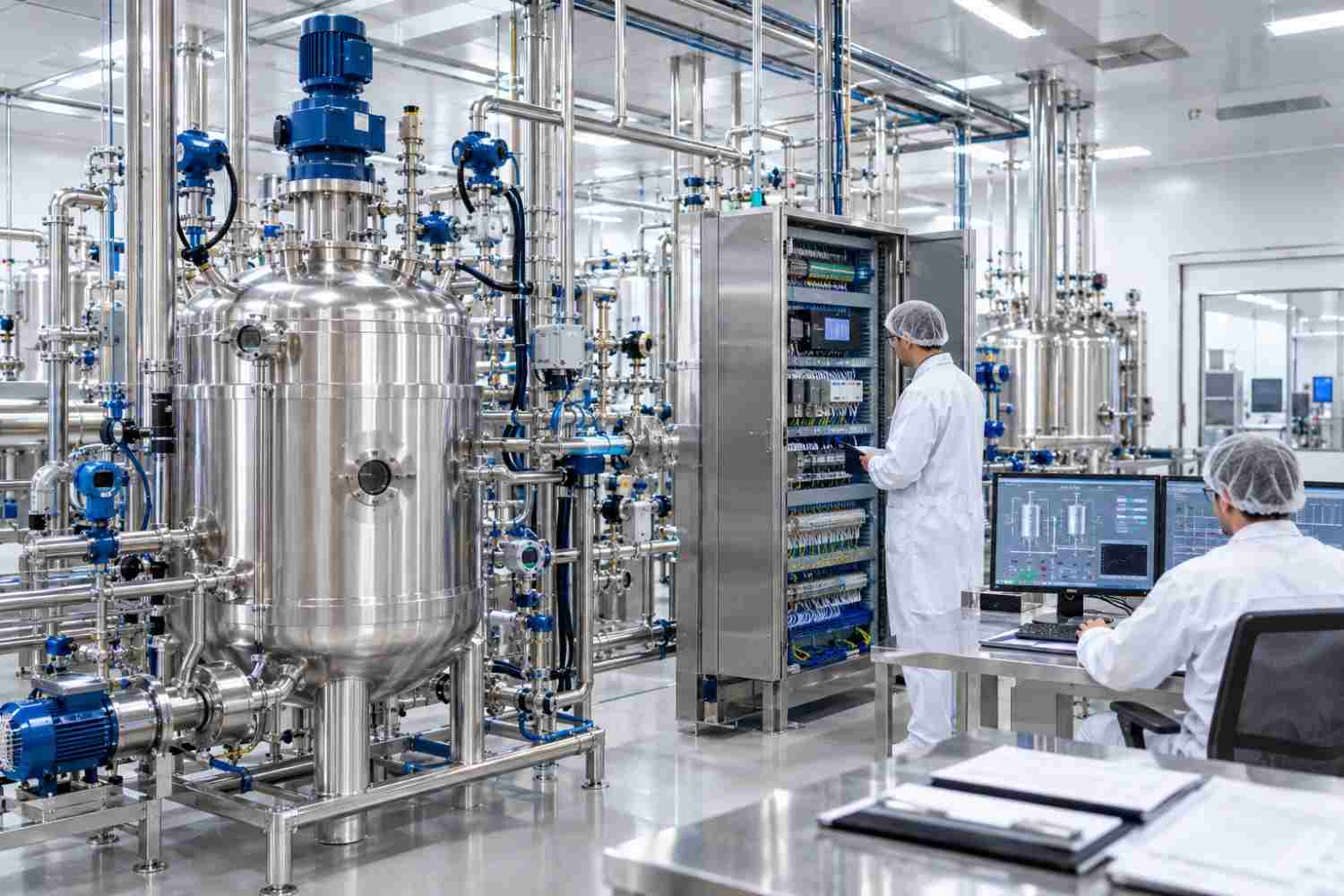
In modern processing plants, tanks, pumps, valves, and measuring instruments are no longer operated manually. Instead, they work in tandem with an industrial automation system that executes processes according to defined operational sequences. The two foundational pillars of this infrastructure are the PLC and SCADA. Integrating piping and equipment design with control systems engineering from the outset is essential for building an efficient, safe, and reliable facility. This article explores the roles of PLCs and SCADA systems and highlights best practices for integrating them with mechanical piping projects.
What is a PLC?
A Programmable Logic Controller (PLC) is an industrial-grade digital computer designed to read signals from field sensors, process inputs based on programmed logic, and command output devices such as valves, pumps, and motors. Operating in real time, PLCs are built to withstand harsh industrial environments. Process steps, safety interlocks, alarm limits, and closed-loop control algorithms are all coded directly into the PLC environment.
What is SCADA?
Supervisory Control and Data Acquisition (SCADA) is the high-level software application layer where plant operators monitor and manage the overall process. SCADA interfaces provide graphical process displays, active alarm lists, historical trend charts, batch recipe managers, and analytical reports. SCADA retrieves operational metrics from underlying PLCs, archives historical data, and routes operator commands back to field devices. In large-scale industrial facilities, multiple distributed PLCs can be unified under a single centralized SCADA network.
The Relationship Between Piping Design and Automation
An automation system is physically anchored to the facility layout. Every automated valve, inline instrument, and motor depicted on a Piping and Instrumentation Diagram (P&ID) directly corresponds to an input or output (I/O) node within the control system. Consequently, the P&ID serves as the baseline design document for both mechanical and automation engineers. Any design adjustment on the piping layout reverberates across control logic, I/O assignment sheets, and field wiring diagrams. Maintaining cross-disciplinary alignment minimizes friction during site commissioning.
Automated Valves and Position Feedback
In sanitary fluid handling, automated valves are typically actuated pneumatically and driven by PLC output cards. To verify that a valve disk has fully shifted to its target open or closed position, physical limit switches or proximity position sensors are integrated into the control top. This feedback loop is essential for establishing interlocks that prevent cross-contamination between product streams and chemical cleaning fluids. Control tops and position sensors must feature washdown-rated, hygienic housings that facilitate clean-in-place routines and easy maintenance access.
CIP and SIP Automation
Clean-in-Place (CIP) and Sterilization-in-Place (SIP) routines represent areas where process automation delivers maximum value. A standard automated cleaning program moves sequentially through pre-rinse, caustic wash, intermediate rinse, acid wash, and final water rinse cycles. Process parameters—including temperature, electrical conductivity, volumetric flow rate, and contact time—are monitored continuously. If a parameter strays from specified limits, the system extends the active step or triggers an operator alarm. Upon cycle completion, parameter logs generate validation reports proving that sanitary standards were met. For turnkey CIP systems, automation architecture must be designed concurrently with mechanical skids.
Recipe Management
When multiple product formulations share the same manufacturing line, process parameters are structured into digitized recipes. A recipe defines setpoints such as target temperatures, agitation mixing durations, dosing volumes, and phase transition sequences. Selecting pre-validated recipes via the SCADA interface reduces human operator error and ensures lot-to-lot consistency. Restricting recipe modification rights to authorized quality personnel and maintaining automated revision logs are vital compliance requirements.
Data Logging and Data Integrity
For pharmaceutical, food, and beverage manufacturing facilities, capturing tamper-evident production and cleaning logs is a mandatory regulatory requirement. Historical data must be stored securely to guarantee that operational records cannot be altered, user actions remain traceable to specific timestamps, and data archives are retained for prescribed lifespans. Achieving complete data integrity requires embedding user access tiers, automated audit trails, and routine database backups into the control system design from day one. Retrofitting data integrity features into an established platform is often complex and costly.
The control software itself requires strict version control and regular data backups. Current master files for PLC code and SCADA configurations must be archived, with every programming modification logged alongside a clear engineering justification. This practice enables rapid system recovery following hardware failures and protects validated software environments against unauthorized, unverified alterations.
Commissioning and Testing
Automation system commissioning is a critical milestone that follows mechanical line installation. Initial signal testing (I/O check) confirms that every field device is correctly wired to its corresponding control module. Subsequent functional testing verifies the physical operation of valves, pumps, and PID control loops. Finally, the entire sequence—including cleaning routines—is tested using water trials. Conducting structured Factory Acceptance Testing (FAT) and Site Acceptance Testing (SAT) ensures systematic verification before introducing live process fluids.
Common Field Challenges
Field commissioning frequently uncovers discrepancies between P&IDs and control software logic, conflicting tag nomenclature across technical submittals, improperly calibrated valve feedback sensors, non-hygienic routing of field cables and pneumatic tubing, or alarm thresholds unaligned with actual line dynamics. Most of these issues can be mitigated during early design stages through cross-disciplinary reviews and centralized document control.
Human-Machine Interface (HMI) screen layouts are sometimes treated as an afterthought. However, intuitive operator interfaces that accurately reflect process logic, display clear alarm hierarchies, and highlight key performance metrics significantly reduce operational mistakes. Involving operators during initial screen design reviews yields a more practical, user-friendly system.
Frequently Asked Questions
Is a SCADA system necessary for a small process skid?
Not always. Small or standalone skids can often be managed effectively using a local Operator Panel (HMI) wired to a single PLC. However, if long-term data logging, complex recipe management, or integration with plant-wide monitoring systems is required, implementing SCADA provides significant operational advantages.
Can automation be retrofitted into an existing manual plant?
Yes. Manual valves can be replaced with automated actuator assemblies, additional inline instrumentation can be installed, and a centralized control network can be introduced in structured phases. Careful engineering analysis is required to evaluate how physical piping modifications impact existing operations.
At what stage should automation engineering begin?
Automation engineering should start as soon as P&IDs reach a mature draft state. Developing mechanical piping layouts and control logic side by side minimizes costly engineering rework and hardware modifications later in the project lifecycle.
PLC and SCADA platforms form the operational core of modern hygienic processing plants, ensuring that mechanical equipment operates safely, consistently, and transparently. Integrating piping layout and automation design accelerates site commissioning while ensuring long-term operational reliability. Within our turnkey projects, we manage mechanical design and control system automation in total alignment. Contact our engineering team to discuss your upcoming project requirements.