

Safe and Durable Solutions with Stainless Steel Argon Welding Service
- Blog
- Safe and Durable Solutions with Stainless Steel Argon Welding Service
Safe and Durable Solutions with Stainless Steel Argon Welding Service
Table of Contents
- Criteria Determining TIG Welding Quality in Hygienic Stainless Steel Piping Lines
- Why Is Back Purging Essential?
- When Is Orbital TIG Welding Preferred?
- How Are WPS and Welder Qualifications Verified?
- Post-Weld Surface and Weld Quality Inspections
- TIG Welding Application Steps in Hygienic Process Lines
In food, beverage, pharmaceutical, and similar high-hygiene processes, the weld quality of stainless steel piping lines is not evaluated solely by the mechanical strength of the joint. The inner surface of the weld area, oxidation status, surface roughness, cleanability, and compatibility with the process fluid must also be taken into account. Therefore, TIG welding application must be handled alongside proper welding procedures and surface controls.
Criteria Determining TIG Welding Quality in Hygienic Stainless Steel Piping Lines
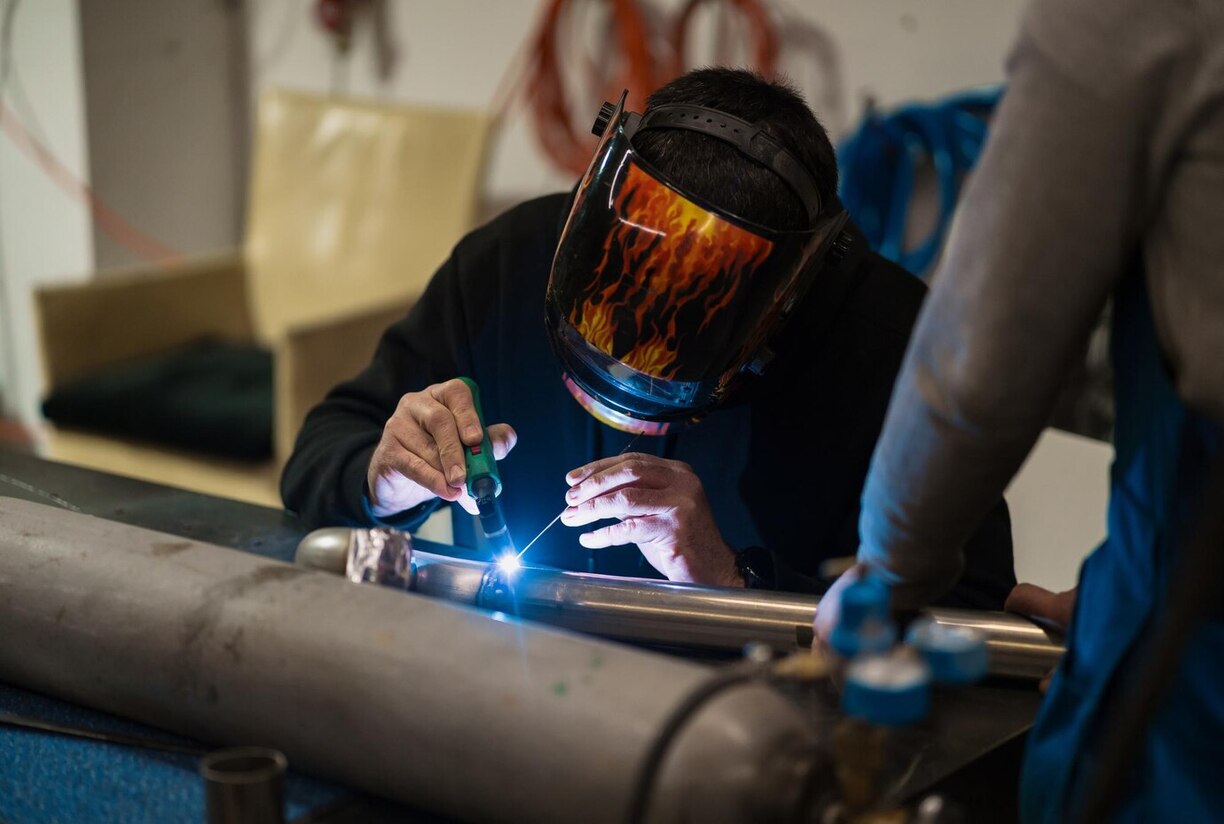
TIG (Tungsten Inert Gas) is an arc welding process performed using a non-consumable tungsten electrode where the weld area is protected by an inert gas. Because it provides controlled heat input and precise weld pool management in stainless steel pipes, it is particularly preferred in thin-walled applications requiring high surface quality.
However, using TIG welding alone does not guarantee a hygienic weld result. Weld quality is determined collectively by material grade, pipe wall thickness, joint geometry, welding current, travel speed, shielding gas conditions, welding procedure, and welder qualification.
In hygienic process lines, the inner surface of the weld zone is particularly critical. The formation of excessive oxidation, irregular weld penetration, or surface defects on the interior surface can adversely affect cleanability and process performance.
For this reason, pre-weld surface cleaning, proper joint preparation, correct gas shielding, and controlled welding parameters must be planned together.
Why Is Back Purging Essential?
Protecting only the outer surface of a stainless steel pipe with argon is insufficient to prevent oxidation on the inside of the weld area. Protecting the inner surface of the pipe with an appropriate inert gas is called back purging.
If air is present inside the pipe during welding, the high-temperature stainless steel surface can oxidize. This leads to dark oxide scales and irregular surface formation at the weld root. In hygienic processes, such a surface condition is highly undesirable in terms of cleanability and corrosion resistance.
In back purging applications, the internal area of the pipe weld zone is filled with inert gas to keep the oxygen level under control. Proper gas flow rate and purge time must be determined based on pipe diameter, joint geometry, and welding procedure. Since an excessively high gas flow rate can create turbulence and cause undesirable gas movements, simply using "more gas" is not a correct approach.
Controlling internal surface oxidation is one of the fundamental criteria for weld quality, especially in food and pharmaceutical process lines where product contact surfaces are critical.
When Is Orbital TIG Welding Preferred?
When multiple joints of similar diameters need to be made reproducibly in hygienic piping systems, orbital TIG welding should be evaluated. In an orbital system, the torch moves around the pipe in a controlled manner, helping to repeat the welding process using defined parameters.
In manual TIG welding, the welder's hand movements and weld pool control can vary the result. In orbital systems, parameters such as current, travel speed, rotation speed, and, if required, filler wire feed can be programmed according to the procedure. This feature significantly enhances repeatability across numerous pipe joints of identical specifications.
Orbital welding offers distinct advantages in hygienic process piping where tight tolerances, controlled weld profiles, and high repeatability are required. However, using orbital equipment alone does not guarantee weld quality. Pipe alignment, bevel preparation, gas shielding, parameter verification, and operator competence must all be evaluated together.
Correct axial alignment of the pipes to be welded and maintaining gap spacing in accordance with specified procedure values are also essential. Misalignment or inconsistent fit-up gaps can make achieving proper weld penetration and the desired internal profile difficult.
How Are WPS and Welder Qualifications Verified?
To ensure industrial welding quality is not left to individual discretion, welding procedures must be formally defined. A WPS (Welding Procedure Specification) is a document outlining the welding method and core parameters to be applied.
A WPS contains information such as material group, welding method, pipe or component thickness, joint type, electrode type, shielding gas, welding position, and core operational parameters. Depending on the project scope, procedure qualification can be verified according to relevant standards such as EN ISO 15614.
The competence of the welding personnel must also be evaluated separately. EN ISO 9606 is one of the primary standards for testing welder qualifications. The welder's certification range must cover the specific welding process, material, and position to be applied.
The purpose of these documents is not merely paperwork. Defining welding procedures and welder qualifications ensures that the same application can be executed reproducibly under controlled conditions and that weld quality remains traceable.
Post-Weld Surface and Weld Quality Inspections
After the welding process is completed, inspecting only the external appearance of the joint is insufficient. In hygienic piping lines, the internal weld root must be inspected just as thoroughly as the exterior surface.
Visual inspection evaluates weld seam continuity, cracks, porosity, excessive oxidation, undercut, and other surface defects. Where required by project specifications, non-destructive testing (NDT) methods can also be utilized.
If weld oxidation or heat tints occur on the internal surface, suitable post-weld surface treatments can be applied according to process requirements. Whether mechanical surface finishing, pickling, or passivation is necessary should be decided based on material specifications, weld condition, and project standards.
It should be highlighted that passivation is not a coating process. Passivation is a chemical surface treatment designed to remove free iron and similar contaminants from the stainless steel surface, serving as one of the critical post-weld surface treatment steps.
Another goal of post-weld inspection in hygienic processes is the early detection of surface irregularities that could cause issues during cleaning and operation. This ensures that weld quality is evaluated not only for mechanical strength, but also against process surface requirements.
TIG Welding Application Steps in Hygienic Process Lines
Applying TIG welding on a hygienic stainless steel pipeline is a controlled process that begins well before the torch is applied to the pipe. The core application steps can be listed as follows:
- Material and Dimensional Control: Pipe materials, wall thickness, and fittings are verified for compliance with project requirements.
- Surface Preparation: Weld zones are cleaned of oil, dirt, and other contaminants. Care is taken to prevent contamination of stainless steel surfaces by carbon steel welding equipment.
- Alignment: Pipe ends are properly aligned, and the root gap is prepared according to procedure specifications.
- Purging (Internal Protection): A suitable purging setup is established to shield the weld root from atmospheric oxidation, ensuring adequate gas protection.
- Controlled TIG Welding: Welding parameters defined in the WPS are executed. Where appropriate, an orbital TIG system is used to ensure repeatable torch movement.
- Visual and Technical Inspection: The weld seam and both inner and outer surfaces are inspected per project requirements.
- Final Surface Treatments: If deemed necessary, appropriate cleaning, pickling, or passivation processes are applied to the weld zone.
- Documentation and Traceability: Welding procedures, materials used, welder/operator details, and required quality control records are maintained according to project scope.
Achieving high-quality TIG welds in hygienic stainless steel piping lines depends not only on choosing the right welding method. Back purging, correct welding parameters, orbital welding technology, WPS, welder qualification, and post-weld surface inspection must all be evaluated collectively.
Especially in food and pharmaceutical processes, ensuring that the inner surface of the weld zone is cleanable, controlled, and aligned with process requirements is paramount. Therefore, welding execution should be treated as a holistic manufacturing process extending from raw pipe material selection to final quality control.