

Designing for Thermal Expansion and Pipe Supports in Stainless Steel Piping
- Blog
- Designing for Thermal Expansion and Pipe Supports in Stainless Steel Piping
Designing for Thermal Expansion and Pipe Supports in Stainless Steel Piping
Table of Contents
- What is Thermal Expansion?
- Consequences of Unmanaged Expansion
- Methods for Managing Thermal Expansion
- Fixed Anchors vs. Sliding Supports
- Support Spacing Criteria
- Hygienic Support Design
- Protecting Equipment Nozzles
- Thermal Cycling and Fatigue
- Implementation in Design and Assembly
- Frequently Asked Questions
- Conclusion
Process pipelines carrying hot purified water, clean steam, hot water for injection (WFI), or heated products elongate when reaching operational temperatures and contract as they cool. This movement is known as thermal expansion. If thermal expansion is improperly managed, it creates severe mechanical stress across pipe runs, induces joint leaks, damages equipment nozzles, and deforms structural supports. In sanitary installations, unmanaged movement can also compromise piping slope, leading to fluid retention and drainage failures. This article addresses how to manage thermal expansion and engineer hygienic pipe support systems.
What is Thermal Expansion?
Metals expand linearly when heated. The total elongation of a pipe run depends on its total length, the temperature differential ($\Delta T$), and the material's coefficient of thermal expansion. Austenitic stainless steels exhibit a higher thermal expansion coefficient than carbon steels, causing stainless steel lines to undergo greater dimensional changes under identical temperature variations. On long, high-temperature lines, this axial elongation generates significant forces that cannot be ignored.
Consequences of Unmanaged Expansion
- Excessive bending and tensile stress across piping and welds, leading to cyclic fatigue cracking over time.
- High reactions transferred directly onto pump casings, tank nozzles, and heat exchanger connections.
- Uneven compression on hygienic clamp gaskets, resulting in process leaks or gasket intrusion.
- Dislodged piping from support guides or structural deformation of hangers.
- Loss of pitch and slope in sanitary lines, forming liquid traps that hinder complete drainage.
- Unintended contact between adjacent pipe runs, electrical trays, or structural steel.
Methods for Managing Thermal Expansion
Managing thermal expansion relies on introducing controlled flexibility into the piping layout. Common engineering methods include:
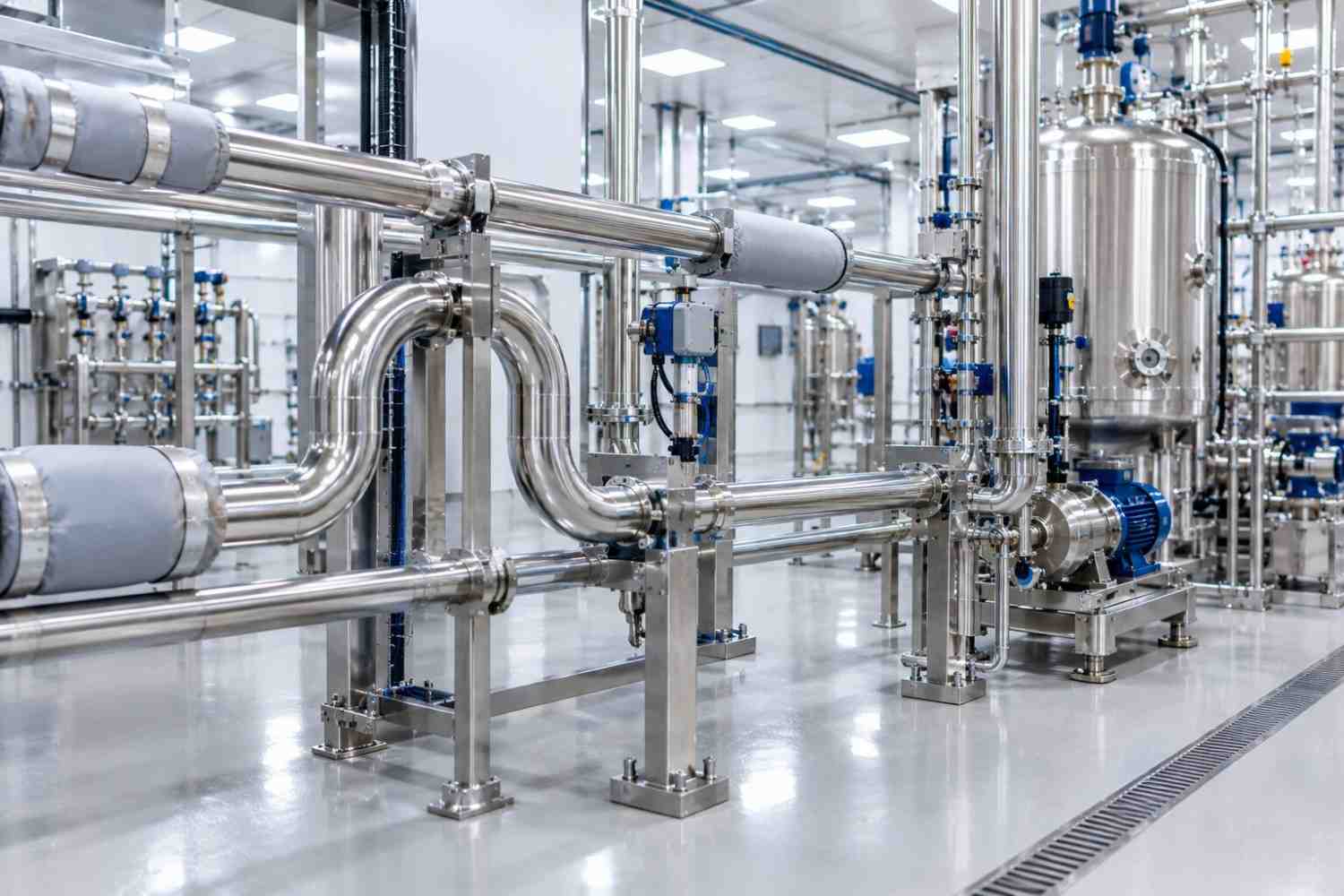
- Natural Flexibility: Directing pipe runs through planned changes in direction (such as L-bends or Z-configurations) allows the network to absorb thermal movement naturally.
- Expansion Loops: Incorporating U-shaped loops along extended straight runs absorbs axial growth through bending legs.
- Bellows Expansion Joints: Metallic expansion bellows can be used in tight spaces; however, their cleanability and dead-leg profiles must be carefully evaluated for sanitary applications.
In hygienic process piping, natural routing flexibility and expansion loops are preferred because they preserve a smooth, cleanable internal profile without introducing mechanical dead legs.
Fixed Anchors vs. Sliding Supports
Managing pipe movement requires a structured arrangement of fixed anchors and sliding supports. Fixed anchors lock the pipe in all three translational directions, forcing thermal movement away from sensitive equipment. Sliding supports carry the pipe weight while permitting axial movement. Guide supports restrain lateral movement to direct expansion along a specific axis. Calculating exact anchor and sliding locations prevents thermal binding and excessive stress accumulation.
Support Spacing Criteria
Support intervals are determined by pipe diameter, wall thickness, fluid density, insulation weight, and allowable deflection limits. In hygienic processing, support spacing carries an additional requirement: mid-span deflection must never compromise the minimum slope required for full gravity drainage. Because thin-walled hygienic tubing (such as ASME BPE standards) exhibits greater deflection under weight than thick-walled schedule pipe, support spans must be spaced closer together.
Hygienic Support Design
Pipe supports inside cleanrooms and hygienic process areas must meet strict cleanability standards. Preferred designs utilize fully enclosed stainless steel profiles, rounded corners, sloped surfaces to prevent water pooling, and smooth finishes. Clamps should incorporate elastomeric liners (e.g., EPDM or silicone) to prevent direct contact between stainless piping and structural steel, eliminating galvanic corrosion and surface contamination while dampening vibration.
Support hardware must also accommodate routine washdown protocols. Clamps should allow easy disassembly for inspection, structural framing should avoid open channels, and floor-mounting hardware must be fully sealed against moisture ingress. Ceiling-hung and wall-mounted supports must adhere to the same hygienic design rules to maintain cleanroom integrity.
Protecting Equipment Nozzles
Process equipment such as pumps, vessels, and shell-and-tube heat exchangers have strict allowable nozzle load limits. When thermal forces from expanding pipe runs transfer onto equipment nozzles, they can cause shaft misalignment, premature mechanical seal failure, or nozzle cracking. Installing fixed anchors near equipment connections combined with flexible routing bends keeps nozzle reactions within manufacturer tolerances.
Thermal Cycling and Fatigue
Sanitary process lines frequently cycle through varying temperature regimes, shifting between ambient production, hot CIP/SIP cycles, and cold rinses. Repeated heating and cooling cycles induce cyclic stress across pipe walls, fitting joints, and weld seams. Over time, thermal fatigue can initiate micro-cracks at points of stress concentration. Engineering flexible layouts that keep operational stress levels low is essential for extending line service life.
Implementation in Design and Assembly
Thermal expansion calculations and support placement should be integrated during 3D modeling. Utilizing 3D design and flow analysis software allows engineers to simulate thermal growth, optimize directional changes, and position anchors accurately. During site installation, quality teams must verify that sliding supports move freely, anchors are secured, and cold-springing (if specified) is properly executed. Observing pipe movement during initial thermal commissioning confirms system performance.
Comparing hot and cold line positions during final commissioning provides an effective field check of thermal expansion design. Any unexpected binding, support tilting, or physical interference can be identified and corrected before commercial production begins.
Frequently Asked Questions
Is thermal expansion analysis necessary for short pipe runs?
Short pipe runs with multiple direction changes often possess sufficient natural flexibility. However, short, rigid connections between fixed equipment nodes must still be evaluated for thermal nozzle loads, especially when operating at high temperature differentials.
Does insulation impact thermal expansion?
Insulation does not alter the metallic pipe's coefficient of thermal expansion, so total growth remains unchanged. However, insulation adds dead weight—which affects support spacing calculations—and requires larger clamp diameters.
Can hot and cold lines share the same support framework?
Yes, provided the support framework is engineered to allow independent movement. The expansion of a high-temperature line must not exert mechanical loads or cause displacement on an adjacent cold line.
Thermal expansion is an unavoidable physical phenomenon in hot hygienic processing lines. By combining flexible routing, engineered anchors, sliding supports, proper span calculations, and cleanable hardware, process lines maintain long-term integrity and full drainability. To learn more about our on-site execution capabilities, explore our installation services or contact our engineering team.