

What Is a Jacketed Tank? Heating and Cooling Jacket Types and Design Criteria
- Blog
- What Is a Jacketed Tank? Heating and Cooling Jacket Types and Design Criteria
What Is a Jacketed Tank? Heating and Cooling Jacket Types and Design Criteria
Table of Contents
- How Does a Jacketed Tank Work?
- Conventional Jacket
- Dimple Jacket
- Half-Pipe Jacket
- Criteria for Selecting Jacket Type
- Jacket Zones and Fill Level
- Insulation and Cladding
- Pressure and Testing Requirements
- Hygienic Design Considerations
- Frequently Asked Questions
- Conclusion
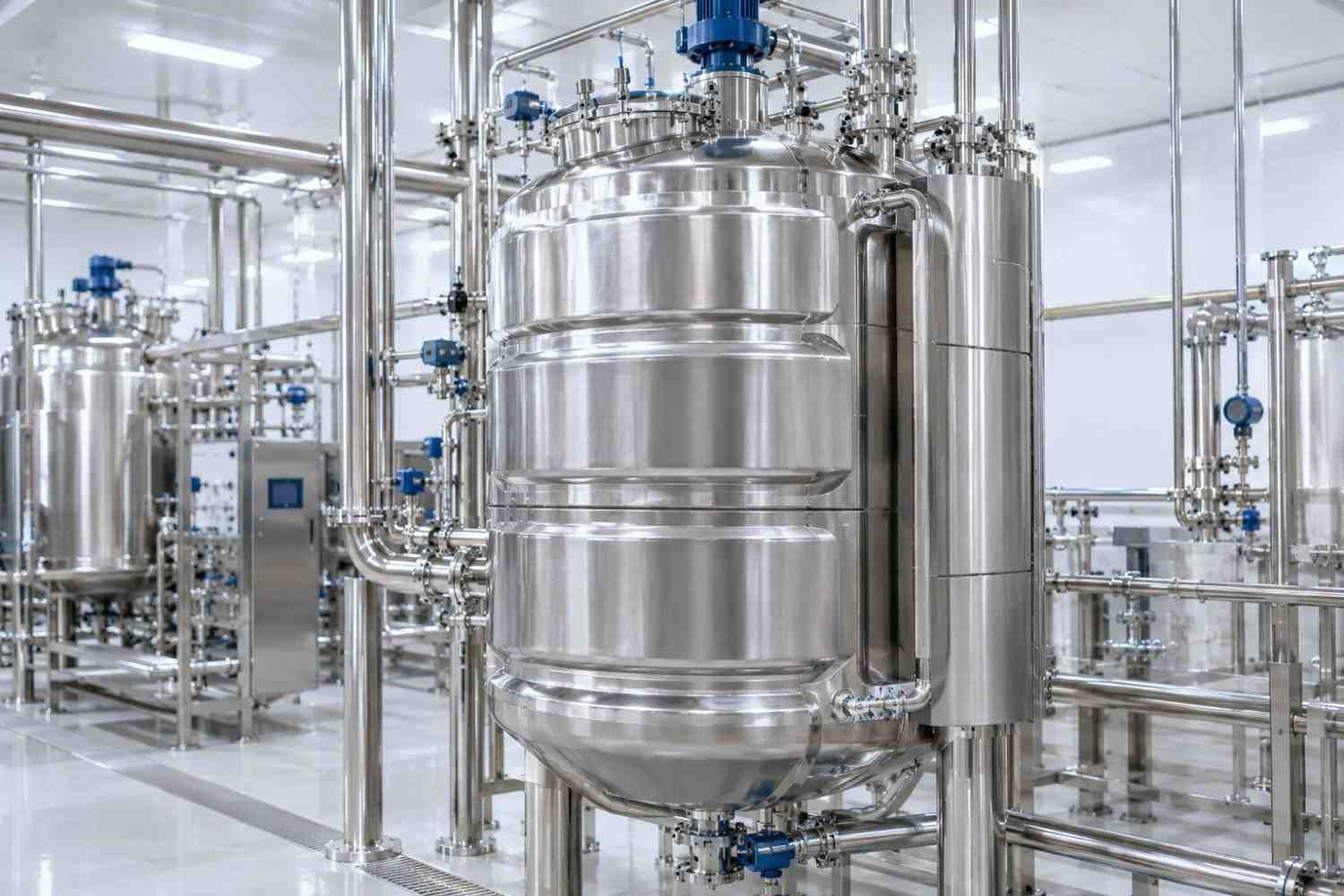
In food, pharmaceutical, cosmetic, and chemical facilities, many processes require product to be maintained at a specific temperature, heated, or cooled. The most common way to meet this need is through jacketed tanks. A jacket is a vessel placed around the outside of the tank shell through which a heating or cooling medium flows. In this article, we cover jacket types, the differences between them, and key criteria to consider when designing jacketed tanks.
How Does a Jacketed Tank Work?
In a jacketed tank, the product is contained within the inner tank shell. The heating or cooling medium circulates in the space between the inner shell and the outer jacket. Heat is transferred to or from the product through the tank wall. Steam, hot water, or thermal oil can be used for heating, while cold water, glycol-water solution, or other refrigerants can be used for cooling.
For efficient heat transfer, it is also essential to keep the product moving inside the tank. Therefore, jacketed tanks are often designed together with an agitator.
Conventional Jacket
A conventional jacket is a second shell surrounding the tank body at a set distance. It has a simple construction and is suitable for low-pressure applications. However, because it has a large fluid volume, the fluid velocity is low, which limits the heat transfer coefficient. Additionally, as jacket pressure increases, the wall thickness of both the inner shell and the outer jacket must be increased.
Dimple Jacket
A dimple jacket is formed by spot-welding a thin sheet to the tank shell at regular intervals and then inflating it. The resulting dimpled structure forces the fluid into turbulent motion and increases heat transfer. Compared to a conventional jacket, it is lighter and withstands higher pressures. It is widely used in steam and cooling water applications.
Half-Pipe Jacket
A half-pipe jacket is constructed by welding pipes cut in half spirally around the tank shell. Because the fluid passes through a narrow cross-section at high velocity, heat transfer is excellent. It is preferred in applications requiring high pressure and temperature, particularly systems utilizing thermal oil. Due to the extensive length of weld seams, manufacturing labor costs are higher.
Criteria for Selecting Jacket Type
- Heating or cooling medium: Steam, water, glycol, or thermal oil—each imposes different pressure and temperature conditions.
- Required heat load: How quickly the product must reach a specific temperature determines the required jacket surface area.
- Operating pressure: As jacket pressure increases, dimple or half-pipe jackets offer distinct advantages.
- Tank size: For large tanks, weight and material costs become decisive factors.
- Zonal control: Dividing the jacket into multiple zones ensures efficient heat transfer at varying fill levels.
- Budget and manufacturing lead time: Each jacket type requires different levels of labor and materials.
Jacket Zones and Fill Level
A tank does not always operate fully filled. The jacket zone below the product level contributes to heat transfer, whereas the zone above the product level is ineffective and can even cause product burning on the exposed inner tank wall. For this reason, especially in tanks operating with varying batch sizes, jackets are designed with separate upper and lower zones. The tank bottom dish is also a critical surface for heat transfer and is often treated as an independent jacket zone.
Insulation and Cladding
To minimize energy loss and protect personnel from hot surfaces, the exterior of jacketed tanks is insulated. The insulation material is typically covered with stainless steel cladding. In hygienic environments, this cladding must be fully welded and sealed; otherwise, washdown water can penetrate the insulation material, reducing thermal performance and creating a microbial hazard. Inclined surfaces that prevent water pooling should be preferred on the cladding.
Pressure and Testing Requirements
A jacket is often an independent pressure vessel operating under pressure. Therefore, design pressures for both the inner shell and the jacket must be specified separately, and hydrostatic pressure tests must be conducted independently. Design calculations must also verify that the inner shell will not collapse under jacket pressure when the tank interior is empty or under vacuum. For tanks falling under pressure equipment regulations, relevant conformity assessments and documentation must be completed thoroughly.
Hygienic Design Considerations
The interior surface of jacketed tanks must comply with hygienic design rules just like any other product-contact equipment. Jacket welds must not leave heat marks or distortions on the inner surface, and the surface quality of the inner shell must be preserved during jacket fabrication. If nozzles and sensor connections pass through the jacketed region, the design of these penetrations must be carefully engineered for both seal integrity and cleanability. SS Proje addresses jacket design in tank manufacturing by integrating thermal requirements with hygienic standards.
Frequently Asked Questions
Can a coil-heated tank be used instead of a jacketed tank?
Coils placed inside the tank can provide high heat transfer; however, they increase the product-contact surface area and make cleaning difficult. For this reason, external jackets are generally preferred in hygienic applications.
Can the same jacket be used for both heating and cooling?
Yes. In this case, the jacket and connected valve manifold must be designed to handle both fluids, and the jacket must be drained between fluid changes to prevent cross-mixing.
Can the jacket type be modified later?
Modifying the jacket of an existing tank is rarely cost-effective. Therefore, the jacket type and zoning configuration should be finalized during the design phase after process requirements are fully defined.
How can heating time be shortened in a jacketed tank?
Heating time is governed by jacket surface area, fluid temperature and velocity, mixing efficiency inside the tank, and product properties. Improving the agitator type and speed, utilizing jacket zones correctly, and increasing flow velocity within the jacket often yield improvements without replacing the tank. For a permanent solution, measuring current heat transfer performance to identify the bottleneck is recommended.
Jacketed tank design requires joint evaluation of heat load, medium type, operating pressure, fill levels, and hygiene requirements. Selecting the right jacket type and zone structure directly impacts both process cycle time and energy consumption. Contact us to determine the most suitable tank and jacket solution for your project.